- Commercial
Renovate or Relocate Your Office? How to Decide
- By QUAY Construction
If your office no longer works, there are two ways out: renovate the space you have or move to a new one. This guide sets out the questions that decide it, with real QUAY numbers for what each path costs in construction. When you are ready to price a specific space, see our office renovation service in Vancouver.
Quick answer. Renovate when your lease has years left, the location still suits your staff and clients, and the problems are ones you can fix inside your walls: layout, meeting rooms, kitchens, lighting and finishes. Relocate when the lease is ending anyway, your team has outgrown the floor area, or the building can’t give you what you need, such as more power, more washrooms or better access. Either way, budget for construction. A move almost always comes with a fit-out of the new space, so the real comparison is renovating here versus moving and building there.
For budgeting before you have drawings, QUAY’s commercial renovation cost guide puts an office refresh at about $90 to $150 per square foot and a full office build-out at about $150 to $250 per square foot for construction in 2026. Those ranges exclude design and engineering fees, permit fees, furniture, IT and AV, signage, specialty equipment and GST.
Renovate or relocate: a quick decision table
| Question | Leans renovate | Leans relocate |
|---|---|---|
| Lease | Years left on the term, or a renewal you want | Term ending soon, or renewal terms you can’t accept |
| Headcount | The team fits the floor area with a better layout | More people than the floor can hold, even rearranged |
| Building | Power, washrooms, heating and ventilation and access can carry your business | The services or access you need can’t be provided in your unit |
| Location | Staff and clients like where you are | Commute, parking or client access is costing you |
| Disruption | Work can run after hours or in phases around your team | You can overlap the old and new leases while the new space is built |
| Landlord | Your landlord will contribute to work as part of a renewal | A new landlord’s allowance covers a large share of the new fit-out |
Most offices land with a mix. Weigh the rows that cost you the most money or the most disruption, then test them with the five questions below.
The five questions that decide it
1. How much time is left on your lease?
The lease sets the timing for both options. Renovating makes the most sense when you will stay long enough to use what you build. If the term ends soon, settle the renewal before you spend money on the space. The City of Vancouver’s commercial lease negotiation guide warns tenants not to assume a lease will renew automatically, and to pay attention to renewal notice, automatic renewal and rate increases. Put the notice date in your calendar before you start planning either option.
The same guide points out that if a building is demolished and redeveloped, the tenant will have to relocate. That is one case where the decision is made for you, and the notice period in your lease is what gives you time to plan the move.
2. Can the space you have fit the team you will have?
Many “we need to move” conversations are really layout problems: private offices nobody uses, too few meeting rooms, no quiet space for calls, or a kitchen that doesn’t suit how people eat. A renovation can rebalance workstations, meeting rooms, collaboration space and storage within the same floor area (our guide to office space optimization covers the ideas). What a renovation can’t do is add square feet. If your realistic headcount needs more floor area than the unit has, even rearranged, relocating or taking more space in the building is the answer.
3. What does each path really cost?
Renovating in place is mostly a construction budget. Using QUAY’s 2026 planning ranges, a 3,000 sq ft office comes to about $270,000 to $450,000 for a refresh and about $450,000 to $750,000 for a full build-out, before the exclusions above. These are planning ranges, not quotes. Our guide to office renovation costs per square foot breaks them down by scope.
Relocating carries a construction budget of its own, because the new unit has to be fitted out for you. On top of that come costs a renovation doesn’t have: moving, IT and phone set-up in the new space, any overlap between the old and new leases, and whatever your current lease requires when you hand the old space back. Read the end-of-lease terms with your lawyer or leasing advisor before assuming the move is the cheaper path.
4. How much disruption can your business take?
Renovating while you stay means building around your staff. On our office projects we plan phasing, access, noise control and work hours around how the business runs, and we work after hours and on weekends where needed. In one occupied medical building on West Broadway, new vinyl plank flooring, ceiling repairs, a sliding window and a full repaint took two weeks, with all the work done after hours and on weekends.
A small office typically takes about four to six weeks of construction once permits are in place and materials are ordered (see how long an office renovation takes). Relocating moves most of the disruption into move week, but only if the new space is built and inspected before your old lease ends, so the fit-out schedule still sets your date.
5. What will the landlord contribute?
A new lease often comes with a tenant improvement allowance: a landlord contribution toward building out the space. If you are renewing instead, ask whether the landlord will contribute to work in your current space as part of the new term. There is no standard amount. The only allowance that counts is the one written into your lease, and it only means something next to a construction budget. Our guide to the tenant improvement allowance in Vancouver shows how to test an offer before you sign.
Moving still means building: a real QUAY example
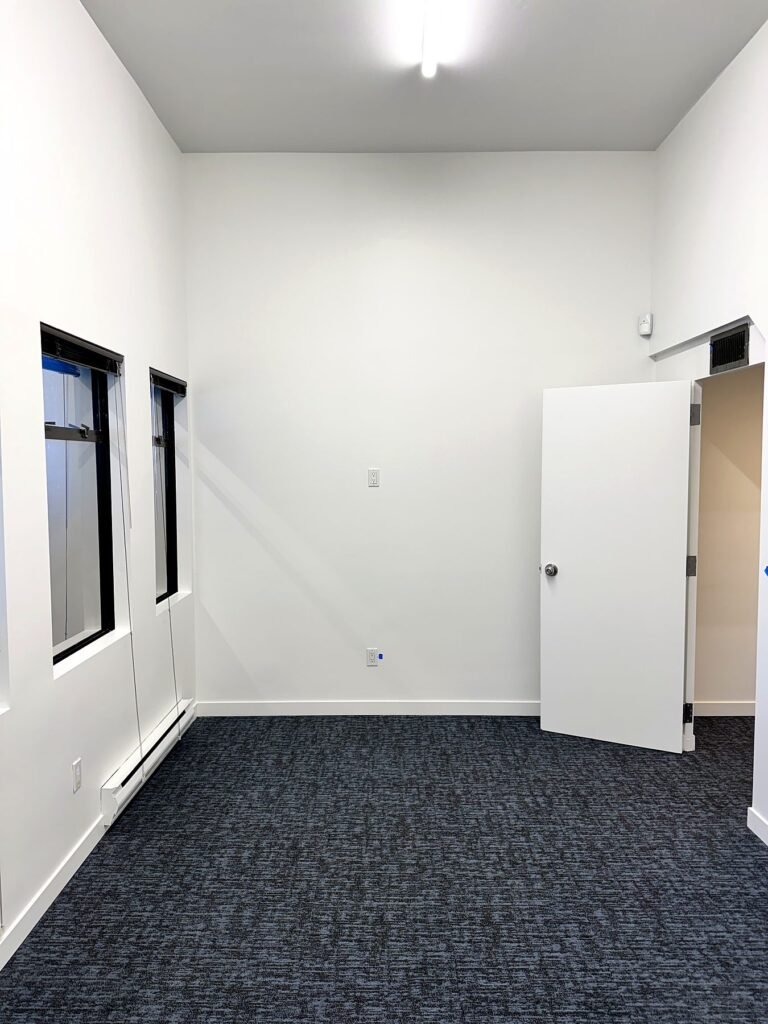
When Five Star Building Services took over an office and warehouse building on Russell Avenue in South Burnaby, the move was only the start. The two-storey office had worn carpet, dated finishes and kitchens that didn’t suit the way the staff use the space, and the rear warehouse was an empty bay with nowhere to store equipment and supplies.
QUAY handled the Five Star office and warehouse renovation from design through construction: two new staff kitchens with custom cabinetry and quartz counters, about 2,500 sq ft of new carpet plus vinyl at the kitchen and entry, about 4,200 sq ft of painting, a refreshed T-bar ceiling upstairs, dedicated IT power and steel pallet racking in the warehouse. Construction took about eight weeks, and the contract came in at $175K to $250K + GST, including approved change orders for a hose bib, extra flooring, IT power and repairs to rotted siding found during the work.
The lesson for anyone comparing options: price the fit-out of the new space as carefully as a renovation of the old one. Commercial leases usually split construction into landlord’s work and tenant’s work, and the tenant’s work is yours to build and pay for. Our walkthrough of what to check before signing a commercial lease covers that split, and the tenant improvement process follows the build from lease to opening. If you are looking at a new unit, the City’s lease guide lists confirming that you will receive City of Vancouver approval to occupy the premises, and reviewing the design, cost and timing of leasehold improvements, as due diligence to complete under an Offer to Lease.
Permits apply either way
Whether you renovate in place or fit out a new unit, work that moves walls or changes plumbing, electrical, ventilation or fire-life-safety systems often needs permits. In Vancouver, the City’s Tenant Improvement Program (TIPs) is a dedicated stream for office tenants in eligible commercial buildings doing minor interior renovations. Any commercial office building constructed with a building permit applied for after January 31, 2007 is eligible. Eligible tenants don’t need a new development permit, and the City aims to complete an initial review and contact applicants within 5 to 10 business days. If you are choosing between buildings, whether a building is eligible for TIPs can affect your schedule. Our office renovation permits guide explains both routes.
How QUAY helps you compare
We can walk your current office and, if you are looking, the unit you are considering, and review the landlord’s and tenant’s work schedules from a construction point of view. We point out gaps such as an electrical service that is too small or ventilation that won’t suit new rooms, and price the work so you can compare renovating against moving with real numbers. Every project then gets a fixed-price proposal that lists the scope, inclusions, exclusions and allowances. Lease terms themselves should be reviewed by your lawyer or leasing advisor.
Weighing a move? Book a discovery call and we’ll help you compare both options for your office.
Renovate or relocate: common questions
Is it cheaper to renovate or relocate an office?
It depends on the condition of both spaces and on your lease. Renovating in place is mostly a construction budget, at about $90 to $150 per sq ft for an office refresh and $150 to $250 per sq ft for a full build-out in 2026, before fees, furniture, IT, signage and GST. Relocating usually adds a fit-out of the new space to moving, IT and lease-overlap costs, so it tends to cost less only when the new space needs little work or the landlord’s allowance covers a large share of it.
How long does an office renovation take compared with a move?
A small office typically takes about four to six weeks of construction once permits are in place and materials are ordered. A move still needs the new space built first: the Five Star office and warehouse in Burnaby took about eight weeks of construction after the company took over the building.
Can we keep working while our office is renovated?
Usually, yes. QUAY plans phasing, access, noise control and work hours around how your business runs, and works after hours and on weekends where needed.
Does a tenant improvement allowance change the decision?
It can. An allowance is a landlord contribution toward building out the space, and the amount is whatever your lease says. Compare it with a construction budget for the unit, not with the rent alone.
Renovate or Relocate?
Related Posts
Bathroom Renovation Ideas From 13 Real QUAY Projects