Best Kitchen Backsplash Material: Tile, Quartz Slab or Glass?
By QUAY Construction · November 23, 2026 · Kitchen
For most Vancouver kitchens, the best backsplash material is either porcelain or ceramic tile, which is durable, easy to clean and the most flexible on budget, or a quartz slab that carries the countertop up the wall with no grout lines at all. Seven of the 11 kitchens on our project pages have a slab backsplash (six of them quartz) and three have tile. With our kitchen backsplash installation service in Vancouver, a backsplash-only tiling job has a $2,500 minimum; inside a kitchen renovation, the backsplash is priced in your fixed-price proposal, and complete Vancouver kitchens typically range from $40,000 to $80,000+.
Natural stone, glass and handmade zellige all work too, but each asks for more care or more planning. This guide compares every common material on the things that matter in a real kitchen: cleaning, grout, heat behind the cooktop, how it meets the countertop, and what it does to cost. Every project example below is a kitchen we built, with the budget published on its project page.
Backsplash materials compared
| Material | Cleaning and upkeep | Install and design notes | Where QUAY has used it |
|---|---|---|---|
| Ceramic tile | Glazed surface wipes clean; grout lines need sealing or a stain-resistant grout | Easy to cut around outlets and windows; huge range of shapes and colours | Dunbar: white gloss subway tile |
| Porcelain tile | Dense and hard-wearing; large formats mean fewer grout lines | Harder to cut than ceramic; large tiles need a flat wall | Listed in our installation scope, including large-format porcelain |
| Zellige / handmade tile | Glaze and edges vary tile to tile, by design; follow the maker's care guidance | Irregular edges and uneven faces are part of the look; grout joints are wider | No QUAY project example yet |
| Quartz slab | Non-porous, no sealing, no grout; one surface from counter to wall | Matches the countertop; outlets are cut into the slab; makers set heat limits | Downtown loft, Moodyville, Kitsilano condo and more |
| Porcelain slab | Non-porous and very heat resistant | Very thin; edges are usually mitred and corners need care | Compared in our countertop guide |
| Marble and natural stone | Porous: needs periodic sealing; marble etches with acids like lemon or vinegar | Every slab or tile is unique; veining has to be laid out | No backsplash example on our project pages |
| Glass | Non-porous and easy to wipe, but shows splashes and fingerprints | Sheet glass has no grout; glass mosaics do; cut-outs are planned before fabrication | Listed in our installation scope |
Two things decide most backsplash choices: whether you want grout lines at all, and whether the backsplash should read as part of the countertop or as its own finish. Slab answers the first with “no” and the second with “part of the counter”. Tile gives you pattern, texture and colour that a slab cannot.
Ceramic and porcelain tile: the dependable default
Tile is still the most flexible backsplash. Ceramic tile is glazed, lighter and easier to cut, which makes it forgiving around outlets, window returns and the ends of upper cabinets. Porcelain is denser and harder-wearing, and it comes in large formats that cut the number of grout lines. Our service page sums up the maintenance side plainly: porcelain and ceramic are among the easiest backsplashes to maintain, and larger tiles mean fewer grout lines to clean.
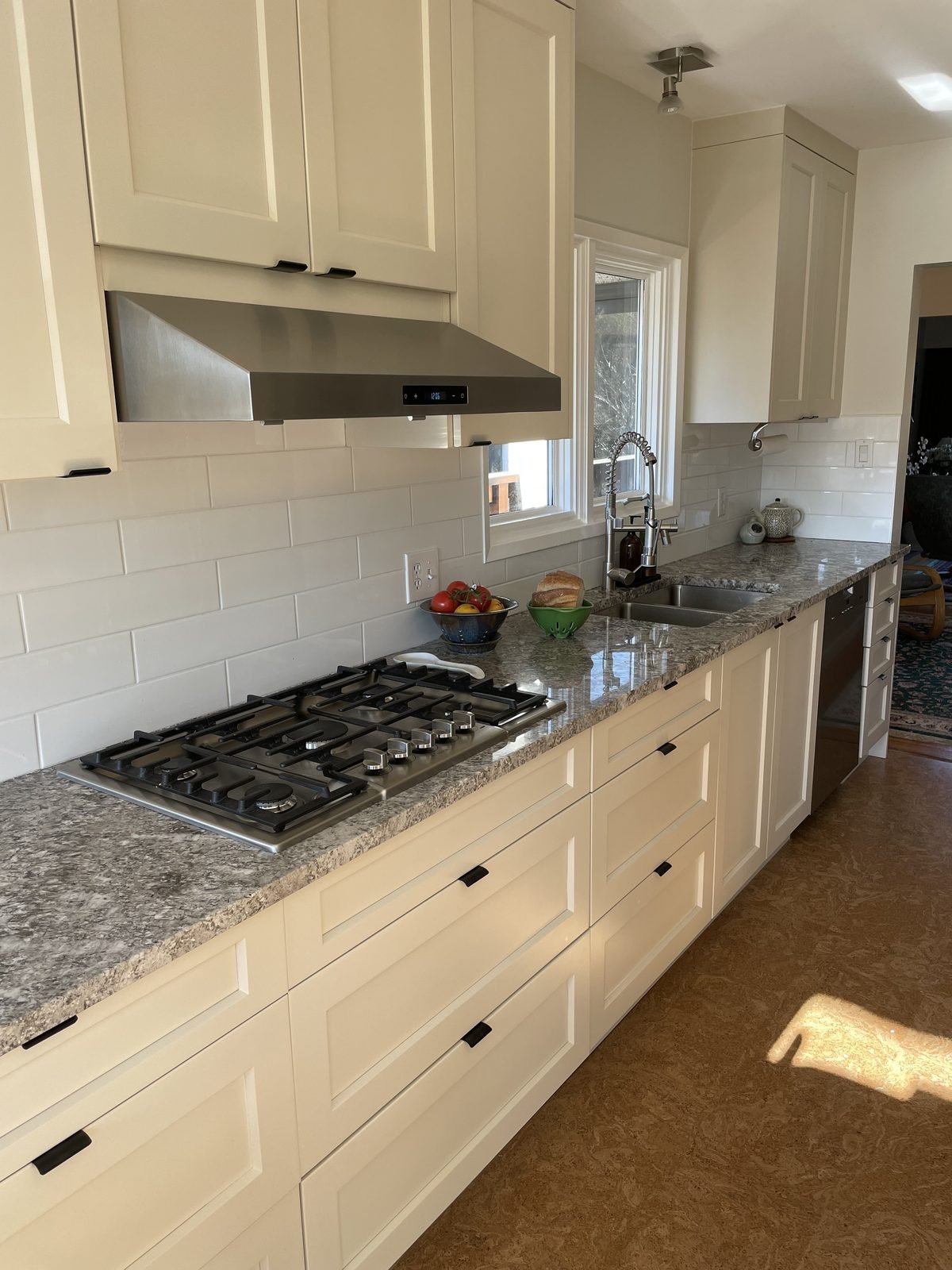
In our Dunbar kitchen, a white gloss ceramic subway tile runs from the grey granite counters up to the upper cabinets, behind a gas cooktop and a new stainless hood. It suits a cream shaker kitchen in a west-side family home, and it shows why subway tile lasts: it sits quietly behind a busy stone pattern. That full kitchen took about 3 weeks on site, and we estimate it would cost $60,000 to $70,000 to build today.
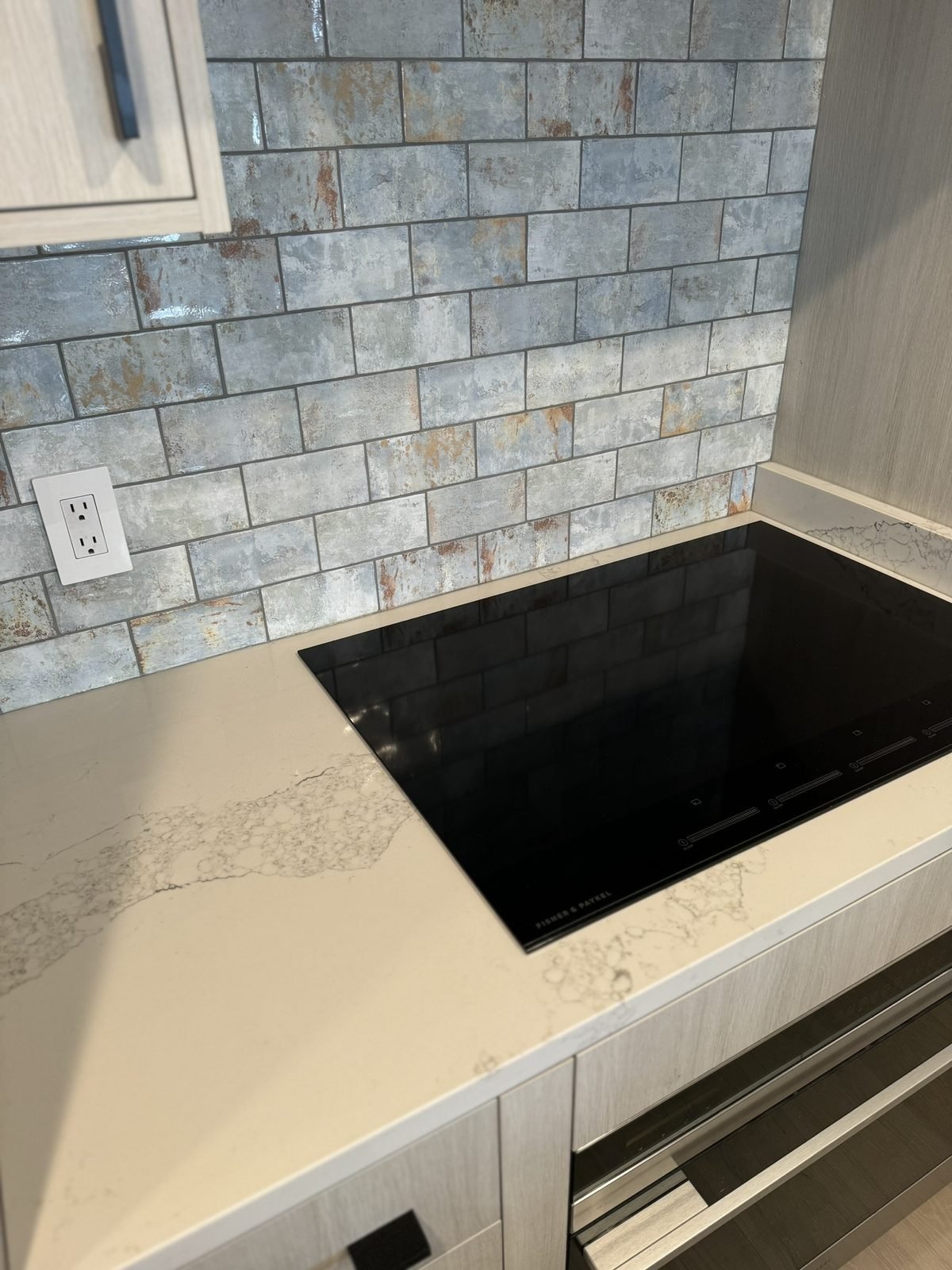
Tile can also be the feature. In our Yaletown open-concept kitchen, a textured brick-format tile sits behind the induction cooktop and wall oven, adding texture to a kitchen that is otherwise light wood grain and quartz. In the Chartwell kitchen in West Vancouver, a neutral backsplash tile runs across the cooking and preparation walls so the curved navy island stays the focal point.
Choose tile if you want pattern or texture, you have granite or a busy countertop, or you want the most control over budget. Plan for grout colour (a grout close to the tile colour hides less dirt but looks calmer), and for where the tile stops at the ends of the run.
Zellige and handmade tile: character, with variation
Zellige and other handmade tiles have uneven faces, softened edges and glaze that changes from tile to tile. That variation is the point: light catches each piece differently, and a wall of them looks alive in a way machine-made tile does not. The trade-offs come with the same character. Joints are usually wider and less uniform, the surface is not perfectly flat, and care depends on the specific product, so follow the maker’s guidance on sealing and cleaning.
Handmade tile works best on a smaller wall or a range wall where it can be the feature, with a quiet countertop beside it. It is not on any of our published projects yet, so we are not quoting a QUAY example here. If you are considering it, bring a sample box to your design meeting: seeing ten tiles side by side tells you more about the variation than any photo.
Quartz and porcelain slab backsplashes: one surface from counter to wall
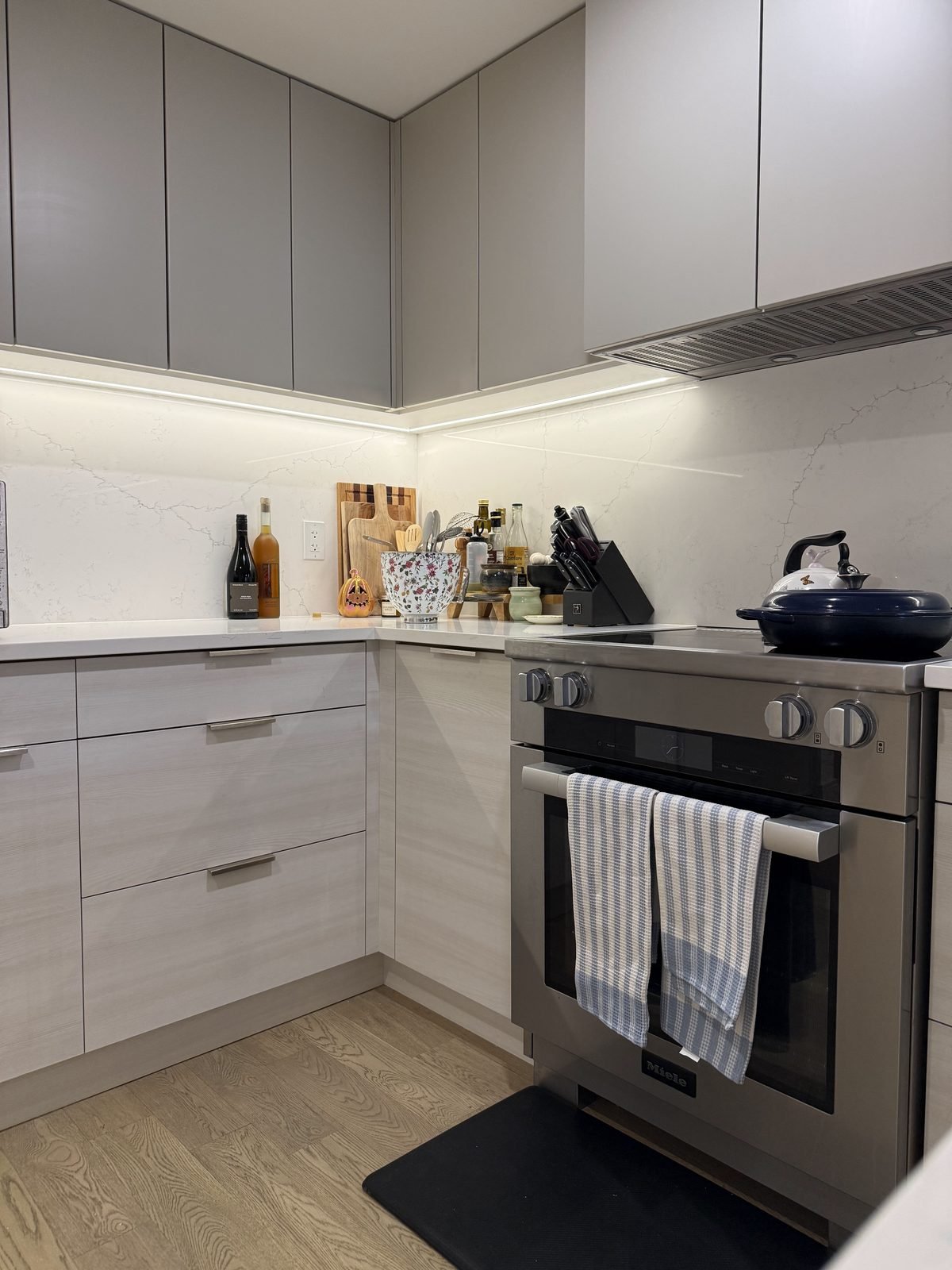
A slab backsplash is the countertop material continued up the wall. There is no grout to clean, the pattern runs unbroken from the counter to the underside of the uppers or all the way to the ceiling, and the kitchen reads as one calm surface. It is the most common backsplash on our project pages, and our quartz vs granite countertops guide explains why quartz suits it: it is non-porous, needs no sealing and looks the same from one end of the kitchen to the other, so matching the wall to the counter is straightforward.
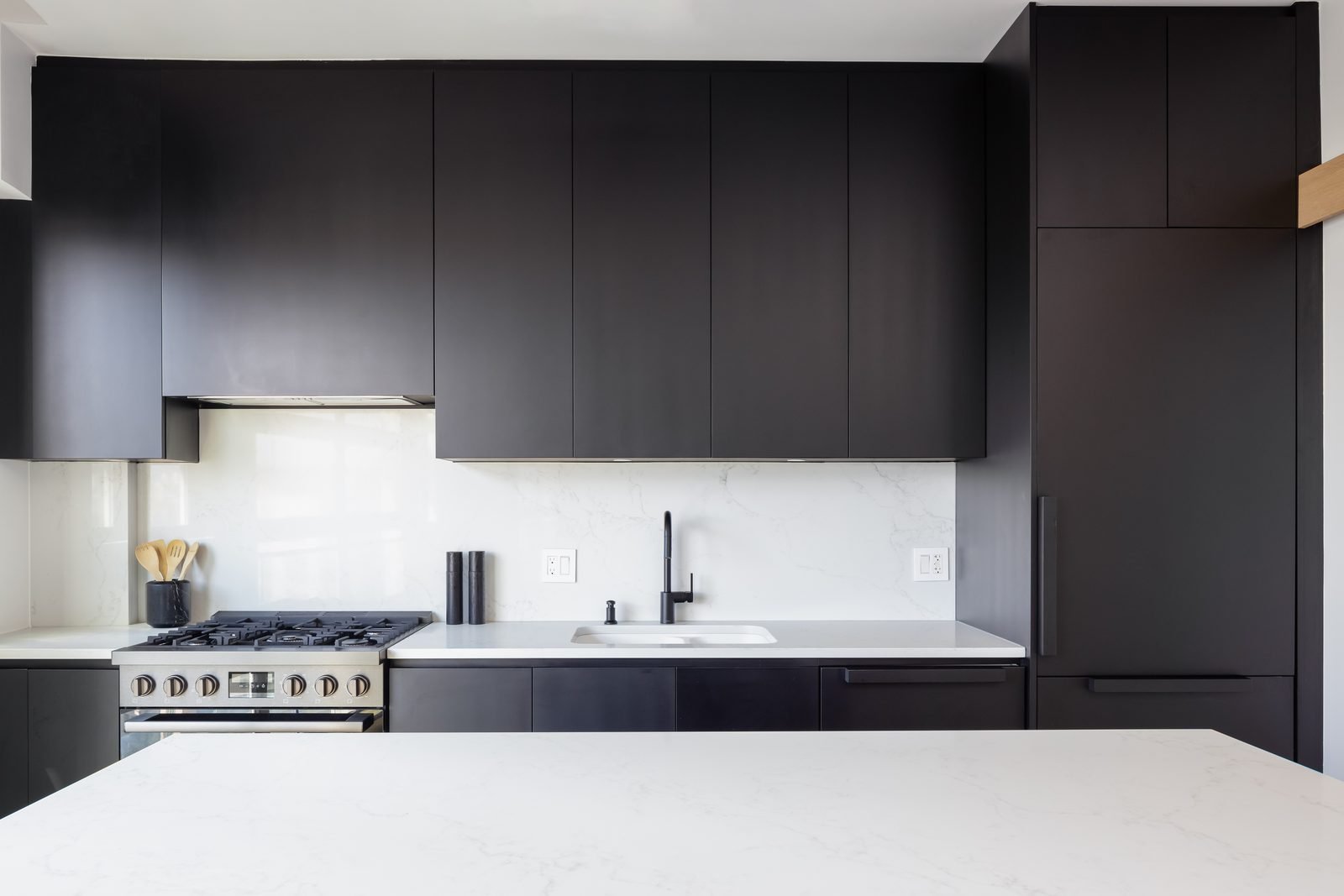
In the Downtown Vancouver loft kitchen, Bianco Gioia quartz covers the counters and runs up the wall as a full-height backsplash behind a 30-inch dual-fuel range, against matte black flat-panel cabinets. The kitchen came in at about $80,000. In Moodyville, North Vancouver, a full-height white slab backsplash replaced a black one behind the range and counters, as part of a partial renovation that kept the layout, upper cabinets and appliances: $24,000 to $28,000 and 10 days on site. Our Kitsilano condo kitchen (about $60,000) and Yaletown condo expansion (about $43,000 + GST) use the same idea in smaller condo kitchens.
Three things to know before you choose slab. First, quartz makers set their own limits on heat, so check the care and warranty sheet for the exact product if the backsplash sits right behind a cooktop. Second, outlets and switches are cut into the slab, so their positions should be settled before fabrication. Third, a slab backsplash is measured and fabricated with the countertop, which ties its schedule to the counter rather than to a tile setter. Porcelain slab is the alternative when heat resistance matters most: it is very heat resistant, but its thin edges are usually mitred and corners are less forgiving of knocks.
Marble, natural stone and glass
Marble and other natural stone give you veining no factory can copy, and a book-matched marble wall is one of the most striking backsplashes there is. Stone is porous, though: it needs sealing from time to time, and marble etches when acids like lemon juice, vinegar or tomato sauce sit on it. Many homeowners who love the look of marble choose a marble-look quartz or porcelain slab behind the cooktop and keep real stone for a lower-risk wall. Granite is tougher than marble, and our Dunbar kitchen pairs granite counters with a tile backsplash rather than a stone one.
Glass is non-porous and easy to wipe, and back-painted sheet glass gives a seamless, reflective wall with no grout at all. The downside is that it shows every splash and fingerprint, and because sheet glass is made to measure, every outlet and switch position has to be fixed before it is ordered. Glass mosaics behave more like tile, with grout lines and easier cutting. Both glass and stone are in our backsplash installation scope alongside ceramic, porcelain, mosaic and large-format tile.
How high should the backsplash go?
Height changes the look and the material quantity more than most people expect. There are three common choices:
- Counter to the underside of the upper cabinets. The standard backsplash, and what our Dunbar kitchen uses: the subway tile runs up to the uppers.
- Full height on walls without uppers. On a range wall with a hood, or a wall with open shelving, the backsplash usually continues to the ceiling or the hood so there is no awkward stop line.
- Full-height slab. The countertop material continues up the wall, as in the Moodyville and Downtown loft kitchens. It costs more material, but it removes grout and visual breaks entirely.
Whichever you choose, decide where the backsplash ends at the sides of the run (at the end of the counter, the end of the uppers or a wall corner) before tile is ordered. That one decision is behind most backsplashes that look unfinished.
What we used in 10 real Vancouver kitchens
| QUAY project | Backsplash | Scope and published budget |
|---|---|---|
| Moodyville, North Vancouver | Full-height white slab | Partial kitchen, $24K to $28K, 10 days on site |
| Downtown Vancouver loft | Bianco Gioia quartz, full height | Custom kitchen, about $80K |
| Shaughnessy | Quartz backsplash matching the counters and island | Fully custom kitchen, $70K to $80K, 3 weeks on site |
| West End condo | Full-height quartz | Kitchen about $60K + GST |
| Kitsilano condo | White quartz full backsplash | Condo kitchen, about $60K |
| Downtown condo | Full-height quartz | Kitchen about $56K + GST |
| Yaletown condo expansion | Full-height quartz | Kitchen about $43K + GST |
| Yaletown open-concept | Textured brick-format tile | Wall removed, about $80K |
| Dunbar | White gloss ceramic subway tile | Full kitchen, $60K to $70K to build today (est.), about 3 weeks |
| Chartwell, West Vancouver | Neutral tile on the cooking and prep walls | Luxury kitchen, about $160K, about a month on site |
The pattern is clear: most of the condo kitchens with quartz counters got a matching quartz backsplash, because it keeps a small kitchen visually quiet and there is no grout to maintain. Tile shows up where the kitchen needed texture (Yaletown), where the countertop was a patterned stone (Dunbar), or where a feature island needed a calm backdrop (Chartwell). For more of these kitchens, see our kitchen renovation ideas from 11 real Vancouver kitchens.
What a backsplash costs with QUAY
We price backsplashes two ways. As part of a kitchen renovation, the backsplash is included in your fixed-price kitchen proposal; complete Vancouver kitchens typically range from $40,000 to $80,000+, and our kitchen renovation cost guide breaks that range down by kitchen size and scope. As a standalone job, backsplash-only tiling has a $2,500 minimum.
We do not publish a per-square-foot price for each material, because the material is rarely what decides the number. What moves the cost of a backsplash is:
- Material and format. Slab is fabricated with the countertop; large-format and handmade tile can take more setting time than standard subway tile.
- Area and height. Full-height walls and range walls without uppers add a lot of area compared with a standard backsplash.
- Cuts and details. Outlets, switches, window returns, open ends and niches all add cutting and finishing time.
- The wall behind it. Removing an old backsplash, repairing drywall and flattening the wall for large tiles is part of the job.
- What else is changing. A new backsplash is often the moment to change counters or lighting too. The Moodyville kitchen combined a new slab backsplash with new quartz, lower cabinet fronts and lighting for $24,000 to $28,000; our partial vs full kitchen renovation guide explains when that kind of scope makes sense.
How a backsplash is installed, and when
The backsplash is one of the last finishes in a kitchen. Countertops, cabinets, lighting and plumbing fixtures should be final before it goes in, because the backsplash has to line up with all of them. Our installation covers surface preparation, layout planning, tile cutting, outlet and fixture detailing, thin-set installation, grouting, silicone at the countertop joint and final cleanup.
Most backsplash installations take about a day, depending on size and material. Slab backsplashes follow the countertop schedule instead, since they are measured and fabricated with it. In a full renovation, the backsplash is part of the roughly 15 working days on site that many of our kitchens take once construction starts; see our kitchen renovation timeline for how the whole sequence fits together.
Can a new backsplash go over the old one? Sometimes. It depends on whether the existing surface is sound and flat, and on how the extra thickness meets the outlets, the cabinets and the counter edge, so we assess each wall before recommending it.
How to choose: four questions
- Do you want grout lines? If not, choose a quartz or porcelain slab, or sheet glass. If you like the rhythm of tile, ceramic or porcelain gives you the easiest upkeep.
- What is your countertop? A quartz counter makes a matching slab backsplash easy. A busy granite or a strongly veined stone usually looks better with a quiet tile, as in Dunbar.
- What happens behind your cooktop? If you cook hot and often, check the heat guidance for the exact slab, consider porcelain, or use tile on the range wall.
- Is this a backsplash job or a kitchen job? A backsplash on its own starts at $2,500 with us. If your counters or lighting are also tired, a partial renovation like Moodyville may change the room far more for the money. For a full redesign, start with our kitchen renovation service in Vancouver.
Still deciding on the look? Our backsplash trends post covers patterns and colours.
Kitchen backsplash FAQ
What is the best material for a kitchen backsplash?
For most kitchens, porcelain or ceramic tile, or a quartz slab that matches the countertop. Tile is durable, easy to clean and flexible on budget; a quartz slab has no grout lines and reads as one surface with the counter. Natural stone and glass also work but need more care or more planning.
Is a tile or a quartz backsplash better?
Neither is better everywhere. A quartz backsplash has no grout, needs no sealing and matches a quartz counter, which is why most of our recent condo kitchens use it. Tile adds texture and pattern, suits patterned stone counters, and is easier to cut around outlets and windows.
What is the easiest backsplash to maintain?
Porcelain and ceramic tile are among the easiest to maintain because they are durable and resist stains, and larger tiles mean fewer grout lines to clean. A non-porous slab such as quartz has no grout lines at all.
How much does a kitchen backsplash cost in Vancouver?
With QUAY, a backsplash-only tiling job has a $2,500 minimum. As part of a kitchen renovation, the backsplash is priced inside the fixed-price kitchen proposal; complete Vancouver kitchens typically range from $40,000 to $80,000+.
How long does it take to install a backsplash?
Most backsplash installations take about a day, depending on size and material. A slab backsplash follows the countertop schedule because it is measured and fabricated with the counter.
Can a backsplash be installed over existing tile?
In some cases, yes, but preparation is critical. It depends on whether the existing surface is sound and flat and how the added thickness meets outlets, cabinets and the counter, so each wall should be assessed first.
Ready to get started?
Tell us about your kitchen and the look you are after, and we will help you choose the material and give you a clear, fixed-price proposal.
Book a discovery callRelated guides
- Quartz vs Granite Countertops (and Porcelain): how each countertop holds up, and which suits a slab backsplash.
- Partial vs Full Kitchen Renovation: what each scope includes and costs, with real QUAY budgets.
- Kitchen Renovation Ideas From 11 Real Vancouver Kitchens: layouts, finishes and what each project cost.